
People tell me all the time that they’re interested in writing their family stories, interviewing older relatives so they can pass down the details for the next generation, have something interesting to share at family reunions. I tell them about the ways they can approach the task, the old-fashioned way with pen and paper, recording interviews on their cell phone, doing a video and audio recording in a virtual format, scrapbooking or creating a photo album with detailed captions. In response I usually get a slight head nod and a lethargic, “That’s a good idea.”
I understand. We’re all busy.
But what if the details you needed to document a good portion of your family story, were much easier to obtain. That was the case for my friend, Nadine Schofield.
As a child, Nadine knew about a box of letters tucked away in a little suitcase in her parents’ closet. Occasionally her mother would read a few of them and reminisce.
“I asked my mother about them and she said, ‘Oh, they’re just some nice things your father said about me,” Nadine said.
Her mother made it clear that the letters were private and Nadine didn’t have permission to read them. Many decades later, her mother gave her permission to read them after she passed away. When her mother died at age 87, Nadine opened the box and what she found surpassed her expectations, hundreds of letters her father wrote to her mother when he was in the U.S. Coast Guard during World War II.
“My father was a good writer,” Nadine said, her face lighting up during our dinner at a Mediterranean restaurant. “The letters highlight my father’s eloquence and wit. It was a real cool love story. It provided me with a deeper insight into my parents’ relationship.”
Written between 1941 and 1946, the letters had yellowed and were musty, but a sweetness rose from the words on each page.
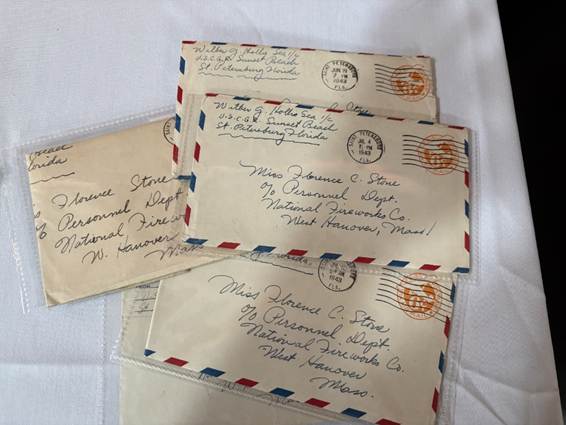
World War II accounts are easy enough to come by in movies, TV shows, documentaries, and books, but the perspective Nadine has gotten from her father’s letters is something rare.
“He wrote a lot about the music of the era, the big bands. He talked about what it was like to go to New York City to see a musical and how grand that was. And then being in California, seeing the Palladium, which was apparently a gigantic dance hall.”
Nadine could have stopped there, reading each letter, treasuring the details of her parents’ love story, but that was only the beginning for her. She felt the letters would be precious jewels for her family, for her son and daughter, their children and the generations to come. A skilled editor, Nadine self-published the letters in book form, including many in their entirety and excerpts of others. It became a family affair. Her brother, Jon, created the cover art and wrote a reflection. A reflection is also included from her brother, Gene.
The result is the 167-page Hurry Home: Love Letters from the War. Family photos, postcards, a military recruiting poster, and newspaper front pages enhance the narratives. “Hurry Home” were the closing words in the last letter received in the collection of letters.