Look for my essay in “Chicken Soup for the Soul: The Dating Game”

Chicken Soup Cover

Chicken Soup for the Soul: The Dating Game is a collection of stories that will encourage you, support you, and make you laugh. It goes on sale at a bookseller near you on December 17th. My essay, “Short Distance Romance,” about how I met my husband, appears in the volume.

It is a thrill to be published by Chicken Soup. For years I have been honored to get my essays and fiction published in literary journals with small press runs. This is the first time my creative writing has been accepted by a mainstream publication. People will actually be able to buy it in brick and mortar and online bookstores. Patrons will be able to pick it off the shelf of their local library.

I will add this to my list of publishing credits, which I hope will help me once I finish my novel and start to look for an agent.

Meanwhile, I’ll be checking the mail for the complimentary copies of Chicken Soup for the Soul: The Dating Game the editors say they’re sending me. And in case you’re stumped for holiday gift ideas, I understand they make great stocking stuffers.

Congrats to James McBride, the National Book Award winner in fiction

National Book Award

I was thrilled to learn that James McBride has won the National Book Award for fiction. I have long been a fan of McBride. His memoir, The Color of Water, has a place of honor on my bookshelf as does his novel, Song Yet Sung. McBride autographed both books for me when I went to hear him speak at an event sponsored by the Friends of the Nashua Public Library in Nashua, New Hampshire a couple of years ago. My literary buddy, Lisa Allen Lambert, the literary life coach, invited me to the event at Rivier College.

During a private wine and cheese reception McBride and I talked about friends we have in common in the journalism field and his techniques for crafting a compelling work of literature. In the background, jazz was playing. I asked McBride if the selections I was hearing were ones he wrote and performed. He smiled slightly and said yes.

From mutual friends I know that in the early days McBride had a lot of ideas for books but nothing on paper. When he did begin the writing, he struggled. It was not easy for him to get to where he is today. People like McBride are an inspiration to people like me, toiling away at that first novel, hoping to one day get published.

The perfect place for a writing retreat

Bed and Breakfast

Croissants

A bed and breakfast that my husband and I stayed at recently in Brattleboro, Vermont, is described accurately on its website as a place for relaxation and renewal, offering the perfect setting for a peaceful, romantic, respite from a busy world. My stay there was indeed restful. The bucolic setting was the perfect place for me to catch up on some R and R and to be pampered. Each morning a tray of tea was left outside our room. Sumptuous breakfast choices included eggs baked in smoked ham, baby spinach, and Grafton Village cheddar cheese  and custard french toast croissants with a hint of nutmeg served with maple-orange sauce, all served in a cozy dining room in front of a cozy fireplace. The B and B was also a great place to catch up on literary pursuits. I sent hours in overstuffed, high-backed chairs catching up on some reading and jotting down notes for revising my manuscript. A B and B can serve as the perfect place for a writing retreat. How about you? What’s your favorite sanctuary for writing?

It’s show and tell time for my manuscript

Book Club

I’ve been working on my novel since 2008. I started with a 10-page sketch, then expanded it month by month as a student in the MFA program in creative writing at Southern New Hampshire University. Now I feel that my manuscript is polished enough for others to see it. I’ve decided to share it with my church book club members. Each month we read and discuss a novel or work of nonfiction. I want them to read mine, let me know what works, where I need to improve it. There are benefits to having personal friends read your work, but there are limitations on what you can expect. For more, read my article on the topic in a special edition of Bookwoman, the Women’s National Book Association national publication.

Where do fiction writers get their ideas?

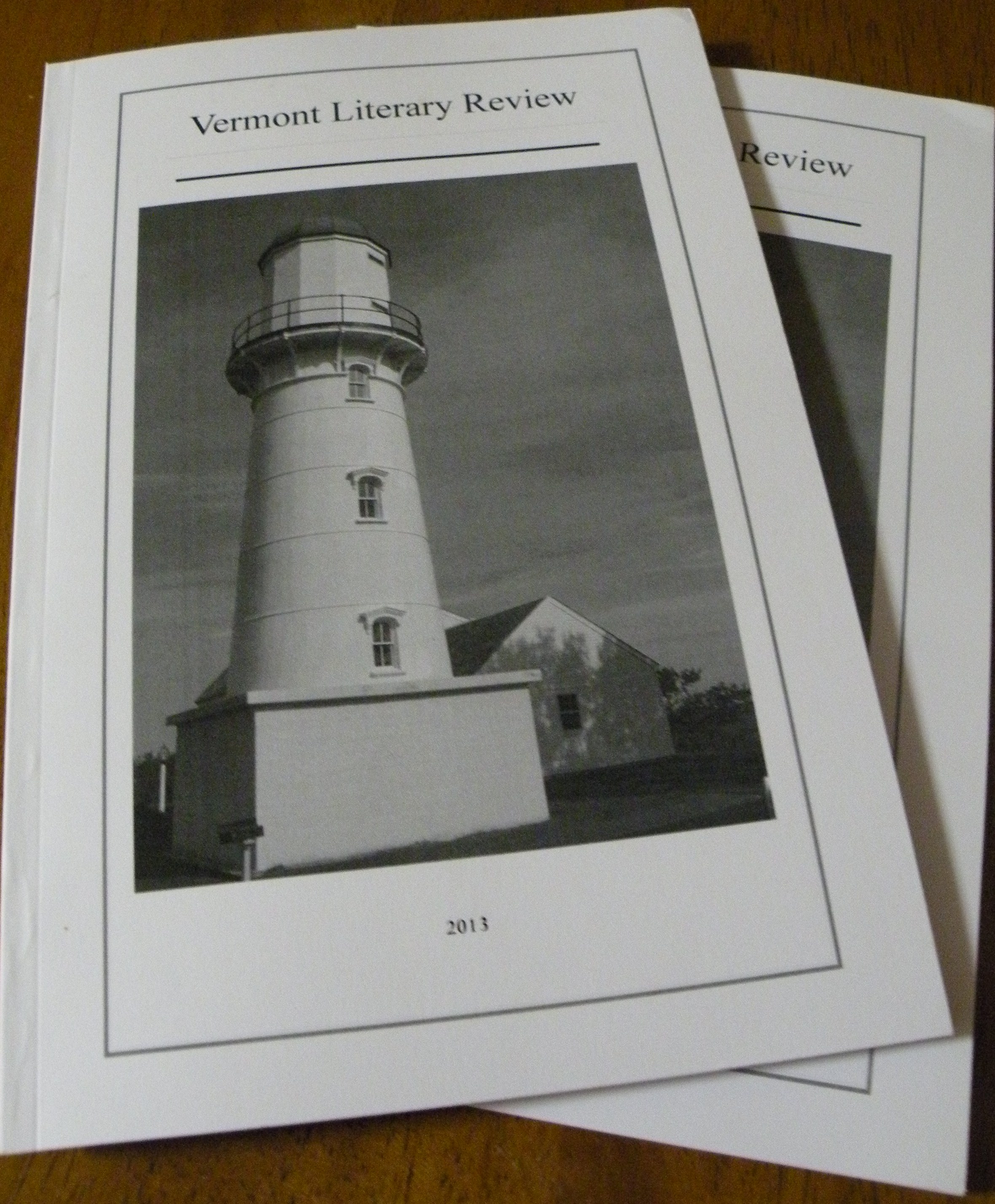
People often ask me where I get the ideas for my stories. In fact, the members of my church book club asked me that question the other day. There’s an interesting story behind “Initiation,” my short story that has just been published in Vermont Literary Review. VLR1A few years ago on a visit to Bridgeport, Connecticut, to spend the holidays with my parents, my mother and I went to the mall to Christmas shop. The list of gifts for my niece and nephew was so long that our backs were hurting from carrying around the shopping bags. My solution was to periodically drop the bags into the trunk of my car, which was on the roof of the parking garage. You can guess what happened. After the last trip to the car, while my mother and I continued shopping, someone took a crow bar to pop the trunk open and stole everything: coats, toys, shoes. My mother and I were in tears. Of course, the items were never recovered.

A few months later I thought about fictionalizing the event. I asked myself what would happen if a mother and daughter had their Christmas gifts stolen from the trunk of the car at the mall, discovered who the thieves were, but then realized that if they revealed who the thieves were, mother and daughter would lose out on something they both desperately wanted. That’s the story behind “Initiation.”


Planning a book party is a lot like planning a wedding

For the past year I’ve been planning my wedding, set for next month. I’ve booked the venue, hired the caterer, secured the gospel quartet. I’ve chosen party favors, and selected the menu. I can’t wait to see what the guests think of the duck confit spring rolls, chicken coq au vin, and strawberry cream cake. Last night I took a break from wedding planning and drove to Brookline Booksmith to attend the book launch of one of Boston’s most celebrated crime fiction writers, Hank Phillippi Ryan. Her latest novel, The Wrong Girl, has just been released by Forge Books.

New Hank PhotoIt was a standing-room-only crowd. Champagne corks were popping. Guests crowded their small plates with hummus, fruit, and gourmet water crackers. The room was peppered with Boston literary luminaries and local television personalities. At least two professional photographers rubbernecked constantly to capture the scene.

As the emcee read Hank’s impressive bio, I noticed her standing a few feet away from me on the fringes of the crowd waiting for her cue. At the appointed time, to thunderous applause, she made her way up the center aisle to the podium. I’m sure some wondered how she stayed afloat on her black stilettos. I wondered why Mendelssohn’s Wedding March was playing in my head. It was in that moment that I realized something: planning a book launch is a lot like planning a wedding.

Launching a book is a major accomplishment so it deserves to be acknowledged. Plus, having a book party is a great way to get people to buy your book. Twenty minutes before Hank appeared, people were lined up at the register to purchase copies of The Wrong Girl.

During her presentation Hank said that after she finished writing her first novel, she thought she could relax. Soon she realized that her work was just beginning.  A book launch requires time, energy, and creativity, much like a wedding. At times when I’ve projected ahead to when my own book is ready for launching I’ve felt overwhelmed at the prospect of planning a book party. Now I can exhale. As I finalize the menu for my wedding reception and confer with my fiancé on the table seating, I am comforted by the fact that planning a wedding has given me a test run for planning a book launch.

In her own words: The Literary Life Coach says there’s a book in everyone

Scratching HeadCoaches are enthusiastic men and women who help us achieve our goals. One of the most visible is the sports coach who works with a team, evaluating athletes’ performances and giving feedback. There is the dialogue coach who works with actors to help them sound convincing before an audience. A dating coach helps individuals pursue healthy relationships. I worked with performance coaches during my broadcasting career to improve my on-air delivery.

But what about writers? Do they have anyone to coach them? If so, who do they go to? What happens to the writer suffering writer’s block, or the writer who can’t get motivated enough to sit in the chair and write the thing, or the writer who’s got a great manuscript but doesn’t know how to market it? That’s where a literary life coach comes in. Lisa Allen Lambert first discovered the lure of writing while researching and writing travel news at Yankee magazine. Later, she wrote, designed, and self-published Eating Clean, a cookbook based on the healing and healthful benefits of unprocessed foods. Recently, an excerpt from her MFA memoir thesis, “Paradise Not Quite Found,” was a finalist in the anthology contest “Times Were A-Changing.”In this exclusive interview, Lisa Allen Lambert, the Literary Life Coach, talks about being a motivator.

Lisa Braxton: What has inspired you to become the Literary Life Coach?

Lisa Allen Lambert: Two things: One, I believe everyone has a book in them. And, two, it was a matter of making official what has long been an avocation: talking with people about their book projects, problem-solving concept and/or structural issues, encouraging writers and following up on their progress. I am a cross-pollinator of people and ideas and love to bring people together; if you meet with me, be sure to bring paper and pen for note taking. As the Literary Life Coach I work with non-fiction writers, primarily business owners, who use a book(s) about their area of expertise to broaden their visibility in the marketplace — to help them make noise in the world. A book keeps your message fresh, long after a meeting or workshop has ended.

L.B.: How does a literary life coach differ from a literary coach? From a writing coach? From a book packager?

L.A.L.: The easy answer first — I am not taking on another author’s book project myself, or collaborating with a publisher, as a book packager would. I function as a writing coach, in that I provide a step-by-step process for growing an idea into a book. Also, I am an accountability partner, a customizable cheerleader. Although I do not proofread, copyedit or edit, I work in tandem with others who do. The word ‘literary’ is my way of implying quality for the end product, the book. In the excitement of seeing their names in print, it is easy for first-time self-publishing authors to overlook the fundamentals such as grammar and spelling. It is my mission to ensure that my clients’ books have integrity, from the inside out.

L.B.: So many authors slog away in privacy and do it all themselves, why would someone need a literary life coach?

L.A.L.: Because writing can be a lonely process, because figuring out how to develop an idea into tens-of-thousands of organized words can be overwhelming.

L.B.: At what stage must a writer’s work be for you to work with him or her?

L.A.L.: Think of my services like a menu — it is possible to order just an appetizer, or an entree, or even dessert, or all three courses. Any stage is the right stage.

L.B.: Do you help with the mechanics of the manuscript? Keeping the writer motivated? Guidance in finding an agent? Marketing the book? Self-publishing?

L.A.L.: All of the above.

L.B.: Tell me of rewarding experiences you’ve had as the Literary Life Coach.

L.A.L.: I’m working with the author of a children’s biography of someone famous. The manuscript has been edited, finely groomed, given the thumbs-up by important people in high places, yet the author needed regularly scheduled check-in sessions to override self-doubt. With the manuscript already in good order, we’ve brainstormed publishing options and marketing strategies. In September I’ll be meeting with the author and her illustrator, an accomplished artist. It is thrilling to seeing this project come to fruition.

I recently had a call from someone who has written several books but described her current project as “writing hell.” She had three versions of the manuscript with input from her team of advisors, and was absolutely stuck on how to organize the chapters, how to edit how some elements that should be used for a different project. How lucky was I that she was vacationing at her lake house, and that we could meet there for a day-long session?! Together we worked out the best flow of information for her book, and, the true test, after sleeping on it, she was energized and focused and back on track.

As the Literary Life Coach Lisa can help you with your nonfiction book or blogging projects. She is the managing editor for Tall Poppy Writers (web site launching in Sept.), a new online consortium that connects smart readers with smart books, and is the assistant residency director for a low-residency MFA program in creative writing. 


Writer by Day, Karaoke King by Night

KaraokeIt’s a Saturday night at independent bookstore Brookline Booksmith and the latest author event is about to begin. The chairs have been arranged. The book signing table has been set up. But before the author, Rob Sheffield, talks about his book, the people attending– in the order in which they signed up–grab a microphone, flip through a booklet of lyrics, and belt out their favorite tunes. Turn Around Bright Eyes, is Sheffield’s story of how he started a new life as a young widower spending nights in New York City karaoke bars. Karaoke played a big part in his emotional journey and led to him meeting his second wife. Karaoke also plays a big part in his book launch, getting readers to come to his events and plunk down the price of a Saturday night dinner to buy his book. 

It’s a clever marketing tool, taking a theme from your written work and making it a vehicle to generate sales. I’m sure plenty of karaoke lovers show up at his events who hadn’t heard of Sheffield before. Some of them probably don’t even read very much. What a great way to build an audience.Gone are the days when authors stood stiffly at podiums, wore drab, rumpled suits with elbow patches, or uninspired pantsuit and blouse/shirt combos to deliver flat presentations.

Authors and publishers are realizing that getting the buying public to pay attention, in this day of flashy video games and fast-paced social networking, requires creative thinking.Cookbook authors have been catching on lately. At Trident Booksellers and Café in Boston’s Back Bay, for example, the author of EATS: Enjoy All the Seconds, has a September 15th engagement to not only talk about her book, but to give a “free” cooking demonstration, billed as an event to ensure that readers will never be faced with tossing away the healthiest foods again. I doubt if all those in attendance, dining on balsamic strawberries and carrot and cumin fritters, will eat and run before making a pit stop at the cash register.This has me thinking.

My novel in progress features an African drummer. I’m making a mental note to book African drummers to do a demo or mini class when I eventually launch my book. I’m curious to know if anyone else has been to a nontraditional book event or hosted one. What other approaches are authors and publishers, and publicists using these days to get a reader’s attention?

Why I won’t let my fiancé read my manuscript

Looking back at my term as president of the Boston chapter of the Women’s National Book Association (WNBA), I have to say that Hank Phillippi Ryan, investigative television reporter for Boston’s NBC affiliate station and author of Prime TimeFace TimeAir Time, and three other books, including a new one due out in September, is one of the most generous authors I know.  Lisa Hank Head and ShouldersThe award-winning crime fiction novelist took time out of her busy schedule to be the keynote speaker at one of our annual year-end dinner banquets. Before an audience of about 30 members and guests in the private dining area of one of Boston’s upscale hotels, she regaled us with stories of how she began writing her first novel. She talked about the long hours in front of the computer screen after her shifts at the TV station, the social events she skipped to carve out time to work on the book, the reams of paper she went through as she revised what she had written. I’m sure she doesn’t know this but her methods provide me with guidance as I work on my own book project. However there was one tactic she told us about that I would feel uncomfortable using: she had her husband read her raw manuscript pages and give her feedback.

I cannot imagine having my fiancé read my manuscript, not a chapter, section, or paragraph. He is also a writer, a very good one, with a background in journalism, like me. I know that he could provide me with insight that would be helpful in polishing the story. However, because my manuscript is so personal, has been a part of my life for more than five years, and because he is so close to me, he is the one person I won’t let read it. I plan to show it to him after it’s published, after it’s been edited, bound, and printed, but not before. Does anyone else feel this way? How do you feel sharing your work in progress with a significant other, whether it’s a writing project, work project, or other personal creative venture? I’d love to hear from you.


The lady with the sharpened pencils in her quiver

Blog Photo


Several years ago I was introduced to S.W., one of my mother’s high school classmates. We’ve been friends ever since. S.W. and I enjoy going to classical music concerts, movies at independent theaters, museums, and dinners at ethnic restaurants.

S.W. and I have made plans to get together in the near future. However, as the date grows near, I am filled with such trepidation that I think about postponing the meeting or canceling it altogether, not because of anything personally involving S.W., but because of something she has in her possession: a copy of the latest revision of my manuscript. S.W. is not only a friend, but a retired editor at one of the country’s top educational and general interest publishing houses. Her ability to shepherd a project from raw manuscript to award-winning literary treasure is legendary.

S.W. didn’t put her sharpened Ticonderoga Number 2’s back in the pencil case when she retired. The woman whips through the New York Times crossword puzzle before her first cup of morning coffee has cooled. She’s been known to call television news reporters on the phone and scold them because they misplaced a modifier during a live report. And those reporters thank her profusely for doing so.

Two years ago I handed S.W. my manuscript and when I got it back it was covered in so much red ink and post-it notes that I thought I’d need a defibrillator to bring my story’s characters back to life. After spending a month decompressing, I read through her edits, which I largely agreed with, and went back to work, confident that I could make the story much better. Now that I’ve handed it back to her again, I feel ill at the prospect of seeing her for our meeting. Who knows what she’ll do? Maybe I’ll need a fire extinguisher to hose the pages down. But it’ll be okay. I value her skills. S.W.’s level of editing is exactly what I need.


In Praise of the “lockdown”

padlockI had been working on the revision of my manuscript, The Talking Drum, for the past two and a half years. It was 75 percent rewritten, but I just couldn’t find blocks of time to power through the rest of it. I’d find an hour here or there at the end of the day at the library or the coffee shop, but by the time I’d familiarize myself all over again with my characters, plot, and subplots, the place would be closing for the evening.  I’d get home only to have the TV and the refrigerator vying for the privilege of distracting me.

Then an idea occurred to me. I decided to go into “lockdown mode.” I found an affordable hotel with just the bare amenities in a boring town in driving distance from home and booked myself a room for an extended weekend. To save money I packed nonperishable food items –peanut butter came in real handy. When I got to the room I tossed the TV remote into the safe and forced myself not to turn on the wi-fi. I flipped open my laptop, pulled out my notes and wrote for four days until my eyeballs felt like sandpaper.

Despite my discomfort, I felt good when I walked out of that hotel bleary eyed and squinting at the sun, because I had achieved my goal.

I know that lockdowns are popular at writing centers. Grub Street writing center, for example, in Boston conducts a lockdown every so often. For a small fee, members can be locked into the classrooms of Grub Street. They write until the lockdown concludes without the distraction of family, friends, or electronic temptations.

Funny. I was telling a friend about my lockdown. She’s a busy mother of young children. She has a fulfilling career and is going for an advanced degree. She suggested that writers aren’t the only ones who could benefit from a lockdown. She began toying with the idea herself.